
A race that was given Grade One status in 2008. The novice version of the staying hurdle division is open to all, as despite Nicky Henderson landing a 1-2 in the race in 2011 Messrs Nicholls and Mullins have yet to claim the race for their stables. With the quality of runner they possess as a group they can strike at any time, but the amount of general attention afforded their runners does nothing to help the performances they produce. Paul Nicholls went close in 2008 (3rd) and 2009 (2nd); Berties Dream and all the big-priced placed horses claimed the podium in 2010; both the main hopes of Nicholls and Mullins were pulled up in 2011; Boston Bob (2nd) had no answers to Brindisi Breeze in 2012; and 2013 went the way of Rebecca Curtis, expectedly so for many. Until anything clearer emerges, this year could be a case of Messrs Henderson and Mullins trying to prevent the trophy from arriving at the Pipe Barn.
Briar Hill's dam was an unraced sister to Boston Bob and, in the same ownership, Briar Hill displays strikingly similar physical characteristics and the concomitant praise of that horse. Where Briar Hill differs from Boston Bob, at this stage, is that he has not been galloped with Hurricane Fly and Quevega. Workmanlike at home, the lack of "hype" saw him ransack the Cheltenham Bumper at 25/1 where as ever "the price" had no physical impact on the horse's performance. Briar Hill's physicality is quite simple to gauge on the basis of his racetrack runs, so any distortion of that physicality is likely to come from inaccurate analysis, "expectation", comments attributed to his trainer and/or comments attributed to his jockey. The following is a selection from wins at Cheltenham, Wexford, Navan and Naas:


Quotes can be used in any number of ways to suit a variety of purposes; here we are only interested in the way in which connections perceive their horse in relation to what can be observed on the track. The word that is misplaced is "speed". None of his hurdle runs display speed. What they may be referring to is the ability to gallop at an elite pace, so that if he can move comfortably with good horses attempting to gallop strongly beyond him then this would indicate tactical pace or, misused, the term "speed". At both Navan and Naas Briar Hill can be clearly seen to switch behind the bridle in extremely small field, moderate gallop races. A horse with "speed" would not need to do this and on better ground this would only be accentuated. At Navan when making all against Azorian his jumping went technically awry as a result most likely of lack of experience: he appeared unsure how to coordinate his effort to race effectively with the timing required to jump. Once he had got rolling more fully, he cleared the last hurdle easily and bounded clear. At Naas he was in second the whole way and chasing a rival with a narrower, more compact physique who was quite quick across his obstacles. There were no problems for Briar Hill; his power behind the bridle was showcased because it took a while to master the horse in front but in the fashion of a good stayer once he had done so that power grew stronger and more effective and he was clear at the line.
Briar Hill himself is a strong, muscular horse. He has good size but not a worryingly large frame. So far he has displayed a number of important aspects. He looks for the time being to be of a sound constitution, having run well and recovered well from three runs already; his mentality is strong so that despite the impression of "only doing enough" he has the even energy distribution required of a stayer and applies himself well at the end of his races; and he has confirmed the initial signs of residual class displayed in his Cheltenham Bumper win. It has to be held in mind that we are unaware of his training programme and that the curve of his physical progression is being shaped towards March, where he will have to "race" from the outset in a big field at Festival pace on better ground, a constellation of factors he will probably relish.
Driven: Briar Hill has strong galloping power when switching behind the bridle

He does not have the "speed" for a Neptune Novices Hurdle, but that assumes that there are runners with a certain profile and with enough class in that race to make that observation a problem and is likely one of the many reasons why his actual race target is yet to be defined. Many trainers with live festival candidates face similar decision-making processes. From Briar Hill's race performances over hurdles to date a novice in the vicinity of The New One's calibre would cause him no end of problems but this is a new year and a different renewal. His chances in the Albert Bartlett will depend on the extent to which his more obvious hurdling limitations - he is likely to become a better chaser than hurdler - can be exposed by his opponents. In that respect one obvious candidate leaps into contention.
King's Palace. His only defeat when completing the course (he fell two out in a soft ground Ayr bumper almost a year ago) came against an opponent he may well face again in this race, the one year older Captain Cutter just outstayed him in a heavy ground Ascot bumper. Captain Cutter won the Grade One Challow Hurdle at the end of December although he has yet to race at three miles (which is fine). King's Palace on the other hand has been driving the miles into his legs with three wins this season over 23f, 26f and 24f, all on good ground, the latter being one of the sponsored trials for this event.
King's Palace displays a varied mix of physical attributes. He is taller and more athletic than Briar Hill, for example; not as muscular in the chest but with a strong stamp of a neck. He gallops exuberantly from the front without being keen and avoids using up unnecessary energy. Not unlike Cue Card, for example, he sets his opponents a test and asks them if they have any answers and, bar being a little green and uncharacteristically moderate over the last two hurdles at Fontwell on debut, nothing he has faced subsequently has been able to pull up a chair for that exam. Wide margin wins are often misleading for one reason or another - Our Conor's Triumph Hurdle victory is a prominent example - but in winning twice at Cheltenham by a combined 32L King's Palace performed with a kind of physicality that offers little doubt about his ability to replicate his running power in a Grade One event.
Keep Up: King's Palace's hurdling has been amongst the best of any novice this season
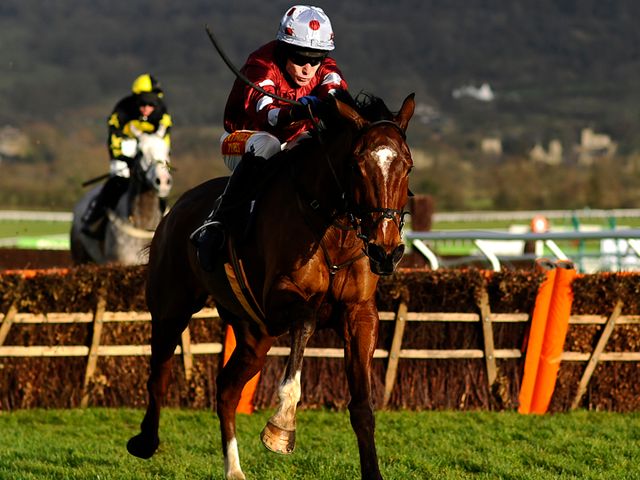
King's Palace's hurdling since his debut win has been outstanding. So far we can say that he rarely breaks stride when jumping despite the high-level gallop he sets himself; his taller, athletic frame seems to help maintain his body position whilst lifting his legs over the hurdle, meaning there is very little loss of momentum at any stage. This technique allied to the level of class he is displaying combine to break his opponents. An interesting aspect of his jumping may link to his bridle ratio, in that what would happen if he made a mistake? Many horses in his division are not travelling as fast or with as much confidence as he does: they may hit or brush through a hurdle but it does not alter their rhythm much as they can quickly pick up their gallop again on the landing side. It may be that a mistake - how serious it would need to be is impossible to say - from King's Palace would hurt the optimal range of his On/Behind bridle ratio. For a horse that races with such power in his own comfort zone, it is questionable how much racing power he would be able to offer when switched behind the bridle. The effectiveness of his weaponry relies on opponents not being able to keep close enough to him in the last quarter of the race, but any mistake(s) would reduce the distance he was in front by and make a challenge from behind the bridle by an opponent a distinct possibility, at which point a clear convergence of available power would favour his pursuer(s). If King's Palace puts in an error-free round he is likely to be extremely difficult to catch in this race, and minor errors are unlikely to alter such a scenario.
Captain Cutter will likely be one of the main pursuers. His win in the Challow Hurdle was impressive perhaps mostly for the fact that he came from last to stay resolutely past the field in heavy ground. However much those conditions clearly suited him well, to do that to opponents in a Grade One contest shows a complimentary mix of racing power. His trainer's assistant summed him up succinctly:

That progression has been energised in a different way to his main rival since beating him in heavy ground on debut in a bumper at Ascot. He has not been asked to run at three miles most likely because only then will he have been trained to deliver his maximum for the season. His races to date show that he grows in strength as his race develops. However, unlike King's Palace, Captain Cutter's hurdling can hinder his rhythm, as it did most notably at Market Rasen over 19f on good to soft ground. He raced more prominently than he would later in the Challow Hurdle, but a mistake at the seventh seemed to set him back a little and his jockey was forced to ensure he outclassed his rivals rather than the horse naturally and easily doing so. Perhaps this was the reason he was allowed to race more in his own time at Newbury on his next start, given that it was a Grade One (albeit in deep ground) and that connections would have been fairly sure he was well up to the required level. As with Briar Hill, the key question for Captain Cutter revolves around whether he has the technical ability to still be in contention should King's Palace deliver the tour de force he is capable of, especially on much better ground than the Challow. Like Briar Hill, the most striking aspect of his physicality is his ability to race powerfully once behind the bridle; but the race may be won by tactical pace rather than force of will.
Let's Roll: Captain Cutter will need to hurdle smoothly for his staying power to become effective

King's Palace. His only defeat when completing the course (he fell two out in a soft ground Ayr bumper almost a year ago) came against an opponent he may well face again in this race, the one year older Captain Cutter just outstayed him in a heavy ground Ascot bumper. Captain Cutter won the Grade One Challow Hurdle at the end of December although he has yet to race at three miles (which is fine). King's Palace on the other hand has been driving the miles into his legs with three wins this season over 23f, 26f and 24f, all on good ground, the latter being one of the sponsored trials for this event.
King's Palace displays a varied mix of physical attributes. He is taller and more athletic than Briar Hill, for example; not as muscular in the chest but with a strong stamp of a neck. He gallops exuberantly from the front without being keen and avoids using up unnecessary energy. Not unlike Cue Card, for example, he sets his opponents a test and asks them if they have any answers and, bar being a little green and uncharacteristically moderate over the last two hurdles at Fontwell on debut, nothing he has faced subsequently has been able to pull up a chair for that exam. Wide margin wins are often misleading for one reason or another - Our Conor's Triumph Hurdle victory is a prominent example - but in winning twice at Cheltenham by a combined 32L King's Palace performed with a kind of physicality that offers little doubt about his ability to replicate his running power in a Grade One event.
Keep Up: King's Palace's hurdling has been amongst the best of any novice this season
King's Palace's hurdling since his debut win has been outstanding. So far we can say that he rarely breaks stride when jumping despite the high-level gallop he sets himself; his taller, athletic frame seems to help maintain his body position whilst lifting his legs over the hurdle, meaning there is very little loss of momentum at any stage. This technique allied to the level of class he is displaying combine to break his opponents. An interesting aspect of his jumping may link to his bridle ratio, in that what would happen if he made a mistake? Many horses in his division are not travelling as fast or with as much confidence as he does: they may hit or brush through a hurdle but it does not alter their rhythm much as they can quickly pick up their gallop again on the landing side. It may be that a mistake - how serious it would need to be is impossible to say - from King's Palace would hurt the optimal range of his On/Behind bridle ratio. For a horse that races with such power in his own comfort zone, it is questionable how much racing power he would be able to offer when switched behind the bridle. The effectiveness of his weaponry relies on opponents not being able to keep close enough to him in the last quarter of the race, but any mistake(s) would reduce the distance he was in front by and make a challenge from behind the bridle by an opponent a distinct possibility, at which point a clear convergence of available power would favour his pursuer(s). If King's Palace puts in an error-free round he is likely to be extremely difficult to catch in this race, and minor errors are unlikely to alter such a scenario.
Captain Cutter will likely be one of the main pursuers. His win in the Challow Hurdle was impressive perhaps mostly for the fact that he came from last to stay resolutely past the field in heavy ground. However much those conditions clearly suited him well, to do that to opponents in a Grade One contest shows a complimentary mix of racing power. His trainer's assistant summed him up succinctly:
That progression has been energised in a different way to his main rival since beating him in heavy ground on debut in a bumper at Ascot. He has not been asked to run at three miles most likely because only then will he have been trained to deliver his maximum for the season. His races to date show that he grows in strength as his race develops. However, unlike King's Palace, Captain Cutter's hurdling can hinder his rhythm, as it did most notably at Market Rasen over 19f on good to soft ground. He raced more prominently than he would later in the Challow Hurdle, but a mistake at the seventh seemed to set him back a little and his jockey was forced to ensure he outclassed his rivals rather than the horse naturally and easily doing so. Perhaps this was the reason he was allowed to race more in his own time at Newbury on his next start, given that it was a Grade One (albeit in deep ground) and that connections would have been fairly sure he was well up to the required level. As with Briar Hill, the key question for Captain Cutter revolves around whether he has the technical ability to still be in contention should King's Palace deliver the tour de force he is capable of, especially on much better ground than the Challow. Like Briar Hill, the most striking aspect of his physicality is his ability to race powerfully once behind the bridle; but the race may be won by tactical pace rather than force of will.
Let's Roll: Captain Cutter will need to hurdle smoothly for his staying power to become effective


