Showing posts with label Oscar Whisky. Show all posts

Thursday, 20 February 2014

JLT Novices Chase 2014: Towards Raceday

* Personal order of preference is indicated by the descending order of reference

Most men pursue pleasure with such breathless haste that they hurry past it
- Søren Kierkegaard

This race has little historicity and is now a Grade One contest for the first time. Its inclusion in the Festival roster has met with widespread frustration given that it adds a clear alternative to the traditional Arkle-or-RSA conundrum but such frustrations arise simply from the compulsion to bet. Analytically the JLT Novices Chase is most welcome: it provides a serious platform for those horses that would clearly be outpaced in an Arkle Chase and for those who lack the physical strength and stamina as a novice to see out a long distance at Festival pace. The former-Jewson calms that breathless haste a little. As a race for novices with an intermediate distance, in some cases it can be difficult to assess the physicality, mentality and stage of progression of the runners. Nonetheless, as a Grade One event at the Festival we are looking for one of the season's top novices with an even distribution of energy, a purposeful preparation and a touch of residual class.

Vukovar is a young (5yo), long and athletic horse with clear physical potential when maturing into his frame, for which he will need time. He has the enthusiasm of youth having run from the front in both his novice chase starts (as a 4yo) this season and it is likely that he has a fairly determined mentality - slight mistakes have not altered the approach he takes to the following obstacle. On debut at Warwick he ran over two miles in Good to Soft ground in a small field where his rival was the enigmatic Mr Mole. It later transpired that connections were disappointed he could not win and he was duly fitted with a tongue-tie for his next start. Here, at Warwick, he raced into an early lead and maintained his gallop until drilling through the top of the second last fence after which his breathing seemed to be affected and he started to wilt. His connections reported that he choked; it could also be that this was his first chase start, his first run in a new country, and his first run since June, so tiring late on could well have been expected. As it was he provided a target for his talented rival to aim at and he was duly mown down comfortably after the last fence by his opponent.

At Newbury in soft ground over 18.5f he again raced from the front but with less exuberance and more control. Unfortunately his only serious rival, Open Hearted, ran as if something was amiss from an early stage and the contest turned into a piece of exercise which but for bundling through the third last he completed with relish. Vukovar clearly possesses a measure of talent - he beat Dell' Arca at Auteuil over hurdles - but at this stage of his career he would be best bullying inferior horses in small fields, using his latent talent allied to his imposing physical strength for a young horse to outmuscle/outpower those opponents. In the heat of a Grade One Festival race with a more frenetic gallop the task before him is to enjoy the experience and run with as much credit as possible. If others falter he may do even better than that. 

Oscar Whisky's physicality has already been discussed here, in relation to the physical characteristics needed for a World Hurdle. It is similar in some ways to that of Cue Card, but not the same. As a hurdler, he was high class. His Cheltenham Festival record is admirable, but there are no wins because none of his four attempts were over his specialist distance of 20f, the trip at which he won two Aintree Hurdles. Fourth in a Supreme Novices Hurdle, third in a Champion Hurdle, fifth in a World Hurdle, then pulled up in a World Hurdle. Never a three-mile stayer, his chasing mission has begun two seasons too late but his target race is over the correct distance for his physical attributes. 

They are: a high level elite class gallop and an On/Behind bridle ratio that spikes to maximum effect in the middle, but with a gun to his head asking for either raw speed/acceleration or stamina/grind the returns diminish significantly at the top level. His mentality has always been excellent. This is quite a heady mix when sent into a novice sphere against horses with more workmanlike profiles. He ran three times over fences at Cheltenham, something his trainer has long been reluctant to do with his best novice chasers. Sprinter Sacre and Finian's Rainbow did not visit Cheltenham over fences until their Arkle Chase runs; Grandouet has been set a similar path. Then again with Oscar Whisky his trainer had very little to learn about him, having raced for four seasons over hurdles at all distances and on all ground. His chase runs have revealed little in many ways, other than his prospective opponents for this race have had little trouble getting competitive with him. From the front or with a lead, Oscar Whisky races in the same way with his mentality ensuring a fullness of effort. He was beaten by Taquin Du Seuil (gave 5lbs), then he beat Taquin Du Seuil (levels) on a desperate weather day with five fences omitted, and in between he mastered Wonderful Charm (gave 8lbs) by half a length making all. In each case, significantly, Oscar Whisky was allowed or was able to distribute his energy evenly and efficiently, and as a result his performances were in the optimal range.

That was not so much the case at Sandown for the three-runner Grade One Scilly Isles Novices Chase. His trainer, perhaps referring to this race in clawing, heavy ground has made it clear that he would rather not run horses than subject them to conditions of this kind but perhaps he may have been caught in two minds because of a desire to get his horse out and running, citing that Oscar Whisky is a "stuffy type" that would benefit from running regularly. Oscar Whisky has a strong mentality as his Aintree successes on the back of Cheltenham "failures" have shown and he needed that here as he did not appear to enjoy the experience at all, his jockey purposefully trying to hold him together in the ground as he struggled to jump out of it and was untidy at many fences. His superior residual class won him the race as with so much of the tiring work done he came back on the bridle when many horses would have been too fatigued to give more and asserting by 9L in tired fashion. One of the difficult things about Oscar Whisky over fences is understanding what he actually needs ideally but middle distances, an elite class pace and better ground would come closest. He will get those conditions in this race and merits respect even if the suspicion remains that a rival with greater progression in his frame and less battle scars will edge past him. 

But for that half length defeat to Oscar Whisky in December, Wonderful Charm would have racked up a four-timer. He is a potentially talented horse, although the reasons why, having not raced since October, he was sent into a World Hurdle field aged only five are best left to his trainer. He obviously summered well, starting his season in October (last year's winner started in September) and then going on to win the Rising Stars Novices Chase at Wincanton (won previously for the same stable by Silviniaco Conti) and the Grade Two Berkshire Novices Chase at Newbury. He then ran Oscar Whisky close at Cheltenham, so that there is the requisite ability present is not in doubt.

Ability is not enough. Having completed his four races in the first half of the season, his trainer stated that he would not run again before the Festival, a gap of three months. Noble Prince (2011) ran in the Grade One Irish Arkle on January 23; Sir Des Champs (2012) ran in a Grade Two at Leopardstown on January 28; and like Noble Prince, Benefficient (2013) ran in the Irish Arkle on January 26. All were Irish-trained, and all had displayed a preference for stamina at some stage in terms of either race distance or run style. Wonderful Charm, too, has run between 20f-22f on each start this season. Highly rated by his stable, he may be a staying chaser in the making but at the moment he perhaps resembles in his run style what Oscar Whisky may have looked like if sent chasing a couple of season ago. Wonderful Charm's On/Behind bridle ratio is very much towards the former. He had a breathing operation after Ruby Walsh reported he didn't feel right in the World Hurdle and this season his performances have been characterised by keenness, travelling notably well on the bridle, and prior to meeting Oscar Whisky outclassing inferior rivals.

This was true at Wincanton where he clattered through the last two fences, ceding lengths to the leader. He was straightened up, gathered in, and responded by picking up again to surge forward and win. This led to post-race comments that suggested 21f was the minimum trip for him but the amount of energy he expends during the "on" aspect of his bridle ratio does not suggest this at all, at least not for his novice season and the fact that he has not been asked to compete over three miles by his trainer perhaps affirms this view. He can race proper, for sure, as he proved against Oscar Whisky but in that race he seemed to display very similar physical attributes to his more illustrious rival. His energy distribution in that race seemed more even, more one-paced, probably because Oscar Whisky had the class to stretch him out of his comfort zone and make him race with different attributes. He responded to a more demanding test well but unlike Oscar Whisky he will still be maturing physically, as he looks to be slightly narrow-chested. Physical growth, a keenness to race, a bridle ratio suggesting his best work is done in his comfort zone and a planned absence from the track may make his task more difficult in March, for all that he appears to have a lot of natural ability.

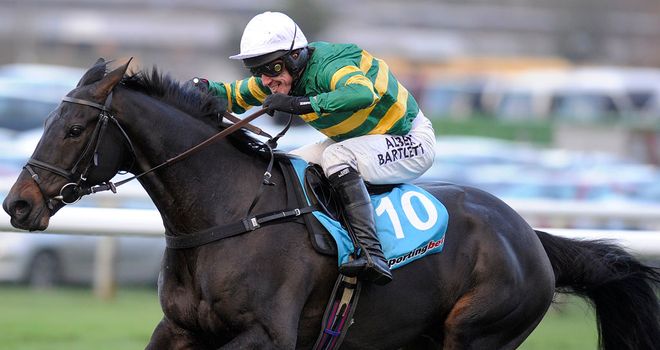
Chest Press: The older Oscar Whisky (right) has more muscular reserves of strength than Wonderful Charm (left) but they were matched closely in ability terms earlier in the season.

Not unlike his more talented grey stablemate, Felix Yonger has been subject to a certain amount of analytical distortion, with many media platforms suggesting he should run in the Arkle Chase, and, furthermore, that he should be the favourite for that contest. The details do not confirm this view, but they should also not take anything away from his own capabilities, which are clearly identifiable.

The reason behind the distortion is an old and recurring one: "form". It is one of the most overused and poorly chosen words when discussing elite novice contests. Felix Yonger beat Defy Logic (pictured, below), then beat Trofolium in a race with a pace collapse; Defy Logic beat Champagne Fever and Trifolium was second; it followed, mutatis mutandis, that Felix Yonger should and Champagne Fever should not therefore run in the Arkle and given that Champagne Fever was favourite and still is favourite for the race that Felix Yonger should be favourite for the Arkle and Champagne Fever should run in the old Jewson. What is his trainer, Willie Mullins, playing at?

Brakes Off, Brakes On: Felix Yonger (left) enjoyed his return to racing early on in the season but his powers have since plateaued 


What can be seen quite clearly are the different targets of different horses in Ireland. Defy Logic was ostensibly an Irish winter ground horse. He has talent but it is not of a kind that would see him fair well in a Cheltenham Arkle Chase. His trainer made specific reference to "the softer the better" for his horse and that his win in the race contested by Champagne Fever was a main target - "delighted to win a Grade One with him" - as was no doubt the hope with the Irish Arkle, where internal bleeding ended his season. In many ways he is reminiscent of the Noel Meade trained Realt Dubh, who had a similarly targeted campaign with an Irish Arkle victory. That horse actually ran with great credit in The Arkle, finishing around 9L third to Captain Chris and Finian's Rainbow. He won again at Punchestown but didn't win another race, his lack of residual class laid bare in open company. Against Felix Yonger, Defy Logic was encountering the quickest ground in his career to date, attempting to make all at a fast pace as usual, only to be picked up late in the contest. What is obvious when watching that race is how Defy Logic was beaten quite early, headed two out from where he was ridden and rousted and visibly tired into a mistake at the last fence. That was not the case against Champagne Fever; they were very different runs owing to different physical stages of his season. Against Felix Yonger he was being geared towards his first winter target and ran accordingly.

Trifolium's breathing problems have been well documented and this was another opponent that went off fast from the front and was unable to sustain his effort, weakening sharply as a tired horse jumping the last fence. When Champagne Fever made a mistake two from home in the Grade One Racing Post Novice Chase at Leopardstown, Defy Logic was then presented the race with Trifolium, who had been in behind them until staying on when his race was over, finishing second. A "perfect form storm" was duly created, but its worth as a reliable analytical tool is low.

Interestingly, the racecourse evidence tells a different story. Not least because just as Felix Yonger was becoming the latest Arkle fashion accessory, he got beat, at Limerick, by his stablemate The Paparrazi Kid. That was over 19f. But instead of asking why he got beaten and what could be learned of his physicality in defeat, rather than victory, the "didn't stay" line was put through the run by those keen to get four steps ahead of his trainer. On the contrary, what can be seen from his Limerick defeat confirms the overall impression of his two victories that he would prefer more of a stamina test on good ground. Ruby Walsh reported how he was close to being taken off his feet by Trifolium. If that is so, then Champagne Fever (and Defy Logic) would have had Felix Yonger in a great deal of trouble had he tried to chase them in their Grade One race, and with no prisoners taken in an Arkle, Hinterland and Grandouet have already shown the trouble a 20f horse can get into against them. At Limerick Felix Yonger was able to move more within his comfort zone and in so doing was happy to 'flick' across the surface with his right front leg, suggesting good ground would be more than welcome (his best run over hurdles was his 7L second to Simonsig in the Neptune Novices Hurdle at the Festival on good ground over 21f). Having moved through the race okay, if a little wide, his best moments came when racing behind the bridle as a couple of moderate jumps left him with a number of lengths to find on the eventual winner, which he set about hunting down with relish, but unsuccessfully, suggesting that there is more to come over slightly further distances. (The winner, The Paparazzi Kid, was notably impressive in this race.) The overriding impression is that Felix Yonger is an eight year old coming into a competitive novice chase arena after a year off the track. He has probably surprised his handlers a little with his exuberance as much as with his early season ability, but Limerick perhaps hinted at a plateau and the task ahead is to condition him for a JLT Novices Chase that will test his ability to both hang onto an elite novice pace and see the race out at the other end.

In his novice hurdle season just gone, TAQUIN DU SEUIL won a Grade Two by six lengths on heavy ground and then the Grade One Challow Hurdle by nine lengths, again on heavy ground. From that three week period there seems to have sprung a concrete association to his name that he "loves" or "needs" some real cut in the ground, which he almost certainly does not. Those Graded races were not very competitive and he was easily the best horse in each race, so when he then ran well for a long way but was ultimately well beaten in a fairly hot Neptune Novices Hurdle (won by The New One) on good to soft Festival ground it served to reinforce the general perception of his required ground conditions from the winter. He also made his chase debut on heavy ground at Ffos Las. Yet analytically the ground is not important for him. He does have a slightly peculiar knee lift but he had no problem out-speeding the "fast" Oscar Whisky on good ground at Cheltenham, where he also showed a tractable mentality to be unaffected by the slow-stop-start gallop early in the race. After the race his trainer revealed the Arkle Chase was still under consideration - he had made My Tent Or Yours work for his victory at Ascot over hurdles on Good to Soft ground (16f) - owing to the speed he displayed at home and presumably by the way in which he bettered Oscar Whisky. True to their word, his next race was in the Grade One Henry VIII Novices Chase at Sandown over two miles, again on good ground. 

This was a no-nonsense fact-finding mission that ended in an 8L defeat and a confirmation that this race is the most suitable one. He got the strong gallop that he most likely thrives upon but this race was notable for its unusual depth: Hinterland and Grandouet were two high class, fast, specialised two milers meeting each other for the second time. Taquin Du Seuil jumped the first two fences well, and was enjoying the early pace too much, pulling his way past Grandouet in third place before settling. The big test came after the first bend as the field started motoring down the back and towards the railway fences. He did well but finally he was bested by the ninth fence, pecking on landing and losing momentum. This brought closer the time he needed to race proper and rounding the final bend he had switched behind the bridle but it was noticeable how well he responded, closing to within three lengths of Hinterland and Grandouet as those two went for everything and scooted clear. Taquin Du Seuil stayed on well to the line, running a fine JLT trial under the cover of an Arkle one.

Carpet: Taquin Du Seuil has produced high class performances this season on Good ground


The Cheltenham re-match with Oscar Whisky, this time on soft ground, produced a similar outcome to their first battle, this time Oscar Whisky narrowly prevailing. But here it was back to a ponderous pace and a race with little intent until it got to the final stages, and it was noticeable how Taquin Du Seuil was ambling at some of his fences, in contradistinction to the helter skelter of Sandown; his most recent win at Haydock on heavy ground was reduced to exercise work when O'Faolains Boy ran with a "desperate" post-race scope (Taquin Du Seuil was nonetheless impressive physically). If we are to assess his optimal conditions then they are those which he has yet to face: 20f, goodish ground (or worse), strong gallop from start to finish - much what he can expect to face in March. He has shown he can handle a variety of challenges and that he himself has more improvement to come, with 16f pace and 20f stamina, allied to tactical speed at the longer distance. A nice blend of physicality. Normal progression permitting, he looks a ready-made Grade One JLT horse and the inference has been made clear that with more time three miles will appear on his radar. He has also demonstrated something that may be crucial: starting in October means he summered well and he has run five times since, once per month and twice in January recovering and developing physically after each race. Soundness permitting, he is in a rich circular vein of training, running and development which can see novices thrive. It will take a high class effort to master him. 

Friday, 3 January 2014

JLT (Jewson) Novices Chase 2014: Preliminary Thoughts


This race has little historicity. It is therefore one that requires a great deal of caution. As a race for novices with an intermediate distance, in some cases it can be difficult to assess the physicality, mentality and stage of progression of the runners. Nonetheless, as a Grade One event at the Festival we are looking for a potentially elite horse with an even distribution of energy, a purposeful preparation and a touch of residual class. In no particular order at this stage:

Oscar Whisky's physicality has already been discussed here, in relation to the physical characteristics needed for a World Hurdle. It is similar in some ways to that of Cue Card, but not the same. As a hurdler, he was high class. His Cheltenham Festival record is admirable, but there are no wins because none of his four attempts were over his specialist distance of 20f, the trip at which he won two Aintree Hurdles. Fourth in a Supreme Novices Hurdle, third in a Champion Hurdle, fifth in a World Hurdle, then pulled up in a World Hurdle. Never a three-mile stayer, his chasing mission has begun two seasons too late but his target race is over the correct distance for his physical attributes. 

They are: a high level elite class gallop and an On/Behind bridle ratio that spikes to maximum effect in the middle, but with a gun to his head asking for either raw speed/acceleration or stamina/grind the returns diminish significantly at the top level. His mentality has always been excellent. This is quite a heady mix when sent into a novice sphere against horses with more workmanlike profiles. He has run all three times over fences at Cheltenham, something his trainer has long been reluctant to do with his best novice chasers. Sprinter Sacre and Finian's Rainbow did not visit Cheltenham over fences until their Arkle Chase runs; Grandouet has been set a similar path. Then again with Oscar Whisky his trainer had very little to learn about him, having raced for four seasons over hurdles at all distances and on all ground. His chase runs have revealed little, other than his prospective opponents for this race have had little trouble getting competitive with him. From the front or with a lead, Oscar Whisky races in the same way with his mentality ensuring a fullness of effort. He was beaten by Taquin Du Seuil, then he beat Taquin Du Seuil on a desperate weather day with five fences omitted, and in between he mastered Wonderful Charm by half a length making all. In each case, significantly, Oscar Whisky was allowed or was able to distribute his energy evenly and efficiently, and as a result his performances were in the optimal range. One of the difficult things about Oscar Whisky over fences is understanding what he actually needs, but it is questionable as to whether a big field and goodish ground at a strong Festival pace is ideal. It could just be that his ideal conditions are those that very nearly seen him record a hattrick from this first three attempts, namely small fields with only one main rival to battle and fend off/get past. 

But for that half length defeat to Oscar Whisky in December, Wonderful Charm would have racked up a four-timer. He is a potentially talented horse, although the reasons why, having not raced since October, he was sent into a World Hurdle field aged only five are best left to his trainer. He obviously summered well, starting his season in October (last year's winner started in September) and then going on to win the Rising Stars Novices Chase at Wincanton (won previously for the same stable by Silviniaco Conti) and the Grade Two Berkshire Novices Chase at Newbury. He then ran Oscar Whisky close at Cheltenham, so that there is the requisite ability of sorts present is not in doubt.

Ability is not enough. Having completed his four races in the first half of the season, his trainer has stated that he will not run again before the Festival, a gap of three months. Noble Prince (2011) ran in the Grade One Irish Arkle on January 23; Sir Des Champs (2012) ran in a Grade Two at Leopardstown on January 28; and like Noble Prince, Benefficient (2013) ran in the Irish Arkle on January 26. All were Irish-trained, and all had displayed a preference for stamina at some stage in terms of either race distance or run style. Wonderful Charm, too, has run between 20f-22f on each start this season. Highly rated by his stable, he may be a staying chaser in the making but at the moment he perhaps resembles in his run style what Oscar Whisky may have looked like if sent chasing a couple of season ago. Wonderful Charm's On/Behind bridle ratio is very much towards the former. He had a breathing operation after Ruby Walsh reported he didn't feel right in the World Hurdle and this season his performances have been characterised by keenness, travelling notably well on the bridle, and prior to meeting Oscar Whisky outclassing inferior rivals.

This was true at Wincanton where he clattered through the last two fences, ceding lengths to the leader. He was straightened up, gathered in, and responded by picking up again to surge forward and win. This led to post-race comments that suggested 21f was the minimum trip for him but the amount of energy he expends on the bridle does not suggest this at all, at least not for his novice season and the fact that he has not been asked to compete over three miles by his trainer perhaps affirms this view. He can race, for sure, as he proved against Oscar Whisky but in that race he seemed to display very similar physical attributes to his more illustrious rival. His energy distribution in that race seemed more even, more one-paced, probably because Oscar Whisky had the class to stretch him out of his comfort zone and make him race with different attributes. He responded to a more demanding test well but there has to be a concern that a lack of racing for such a long period of time allied to his natural keenness and a more sustained and fierce festival pace will break any finishing effort his bridle ratio can command at this stage in his career. Unlike Oscar Whisky he will still be maturing physically, as he looks to be slightly narrow-chested. Physical growth, a keenness to race, a bridle ratio suggesting most work is done 'on' it and a planned absence from the track may make his task rather difficult in March, for all that he appears to have a lot of natural ability.

Strength: The older Oscar Whisky (right) has more muscular reserves of strength than Wonderful Charm (left) but they were matched closely in ability terms earlier in the season.

In his novice hurdle season just gone, Taquin Du Seuil won a Grade Two by six lengths on heavy and then the Grade One Challow hurdle by nine lengths on heavy. From that three week period there seems to have sprung a myth that he "loves" or "needs" some real cut in the ground, which he almost certainly does not. Those Graded races were not very competitive and he was easily the best horse in each race, so when he then ran well for a long way but was ultimately well beaten in a fairly hot Neptune Novices Hurdle (won by The New One) on good to soft Festival ground it served to reinforce the general perception of his required ground conditions from the winter. He also made his chase debut on heavy ground at Ffos Las. Yet analytically the ground is not important for him. He does have a slightly peculiar knee lift but he had little problem out-speeding the "fast" Oscar Whisky on good ground at Cheltenham, where he also showed a tractable mentality to be unaffected by the slow-stop-start gallop early in the race. After the race his trainer revealed the Arkle Chase was still under consideration, owing to the speed he displayed at home and presumably by the way in which he bettered Oscar Whisky. True to their word, his next race was in the Grade One Henry VIII Novices Chase at Sandown over two miles, again on good ground. 

This was a no-nonsense fact-finding mission that ended in an 8L defeat and a confirmation that the Jewson is indeed the right race. He got the strong gallop that he most likely thrives upon but this race was notable for its unusual depth: Hinterland and Grandouet were two high class, fast, specialised two milers meeting each other for the second time. Taquin Du Seuil jumped the first two fences well, and was enjoying the early pace too much, pulling his way past Grandouet in third place before settling. The big test came after the first bend as the field started motoring down the back and towards the railway fences. He did well but finally he was bested by the ninth fence, pecking on landing and losing momentum. This brought closer the time he needed to race proper and rounding the final bend he had switched behind the bridle but it was noticeable how well he responded, closing to within three lengths of Hinterland and Grandouet as those two went for everything and scooted clear. Taquin Du Seuil stayed on well to the line, running a fine Jewson trial under the cover of a strong Arkle one. 

The Cheltenham re-match with Oscar Whisky, this time on soft ground, produced a similar outcome to their first battle, this time Oscar Whisky narrowly prevailing. But here it was back to a ponderous pace and a race with little intent until it got to the final stages, and it was noticeable how Taquin Du Seuil was ambling at some of his fences, in contradistinction to the helter skelter of Sandown. If we are to assess his optimal conditions then they are those which he has yet to face: 20f, goodish ground, strong gallop from start to finish - much what he can expect to face in March. He has has shown he can handle a variety of challenges and that he himself has more improvement to come, with 16f pace and 20f stamina, allied to tactical speed at the longer distance. A nice blend of physicality. Normal progression permitting, he looks a ready-made Jewson horse. 

Across the water, nearly all the talk has fallen on Felix Yonger and Champagne Fever. Discussion of the latter will feature in relation to the Arkle Chase as that is where his level of residual class would be best served. Not unlike his more talented stablemate, Felix Yonger has been subject to any amount of analytical distortion, with many media platforms suggesting he should run in the Arkle Chase, and, furthermore, that he should be the favourite for that contest. The details do not confirm this view, but they should also not take anything away from his own capabilities, which are clearly identifiable. (He is eight years of age, for those adhering to the Steps model of profiling.) 

The reason behind the distortion is an old and recurring one: "form". It is one of the most overused and poorly chosen words when discussing elite novice contests. Felix Yonger beat Defy Logic, then beat Trofolium; Defy Logic beat Champagne Fever and Trifolium was second; it follows, mutatis mutandis, that Felix Yonger should and Champagne Fever should not therefore run in the Arkle and given that Champagne Fever was favourite and still is favourite for the race that Felix Yonger should be favourite for the Arkle and Champagne Fever should run in the Jewson. What is his trainer, Willie Mullins, playing at?

That Felix Yonger may run in the Arkle is a possible scenario, of course, but it is unlikely and Felix Yonger's appeal in an Arkle would be limited. What can be seen quite clearly are the different targets of different horses in Ireland. Defy Logic is an Irish winter ground horse. He has talent but it is not of a kind that would see him fair well in a Cheltenham Arkle Chase. His trainer has made specific reference to "the softer the better" for his horse and that his win in the race contested by Champagne Fever was a main target - "delighted to win a Grade One with him" - as no doubt will be the Irish Arkle. In many ways he is reminiscent of the Noel Meade trained Realt Dubh, who had a similarly targeted campaign with an Irish Arkle victory. That horse actually ran with great credit in The Arkle, finishing around 9L third to Captain Chris and Finian's Rainbow. He won again in Punchestown but didn't win another race, his lack of residual class laid bare in open company. Against Felix Yonger, Defy Logic was encountering the quickest ground in his career to date, attempting to make all at a fast pace as usual, only to be picked up late in the contest. What is obvious when watching that race is how Defy Logic was beaten quite early, headed two out from where he was ridden and rousted and visibly tired into a mistake at the last fence. That was not the case against Champagne Fever; they were very different runs owing to different physical stages of his season. Against Felix Yonger he was being geared towards his first Winter target and ran accordingly.

Trifolium's breathing problems have been well documented and this was another opponent that went off fast from the front and was unable to sustain his effort, weakening sharply as a tired horse jumping the last fence. When Champagne Fever made a mistake two from home in the Grade One Racing Post Novice Chase at Leopardstown, Defy Logic was then presented the race with Trifolium, who had been well behind until staying on when his race was over, finishing second. A "perfect form storm" was duly created, but its worth as a reliable analytical tool is low.

Interestingly, the racecourse evidence tells a different story. Not least because just as Felix Yonger was becoming the latest Arkle fashion accessory, he got beat, at Limerick, by his more limited stablemate The Paparrazi Kid. That was over 19f. But instead of asking why he got beaten and what could be learned of his physicality in defeat, rather than victory, the "didn't stay" line was put through the run by those keen to get four steps ahead of his trainer. On the contrary, what can be seen from his Limerick defeat confirms the overall impression of his two victories that he would prefer more of a stamina test on good ground. Ruby Walsh reported how he was close to being taken off his feet by Trifolium. If that is so, then Champagne Fever (and Defy Logic) would have had Felix Yonger in a great deal of trouble had he tried to chase them in their Grade One race, and with no prisoners taken in an Arkle, Hinterland and Grandouet have already shown the trouble a 20f horse can get into against them. At Limerick Felix Yonger was able to move more within his comfort zone and in so doing was happy to 'flick' across the surface with his right front leg, suggesting good ground would be more than welcome (his best run over hurdles was his 7L second to Simonsig in the Neptune Novices Hurdle at the Festival on good ground). Having moved through the race okay, if a little wide, his best moments came when racing behind the bridle as a couple of moderate jumps left him with a number of lengths to find on the eventual winner, which he set about hunting down with relish, unsuccessfully, suggesting that there is more to come over slightly further distances. The overriding impression is that Felix Yonger is an eight year old coming into a competitive novice chase arena after a year off the track. He has probably surprised his handlers a little with his exuberance as much as with his early season ability, but Limerick perhaps hinted at a plateau and the task ahead is to condition him for a Jewson Novices Chase that will test his ability to both hang onto a fast pace and see the race out at the other end.

In terms of raw ability there may not be too much between these key four runners, suggesting even more reason to pay attention to specific aspects of their physicality and mentality in the coming weeks.

Sunday, 22 December 2013

World Hurdle 2014: Preliminary Thoughts

* The problems afflicting At Fisher's Cross were stated to be "well known" by her trainer. This is highly questionable. On December 28, 2013, for the first time so far as can be seen, they were stated clearly: hock, back and rib issues
** Solwhit subsequently missed his intended reappearance run with a suspected sprained fetlock, which would not be serious and is unrelated to previous injuries. It it is more serious his preparation for and participation in the race would be compromised. The injury will be updated when known. 


Still undefeated, Big Buck's remains in the Super-Elite bracket. The greatest staying hurdler of all time, his absence from the 2013 renewal and remainder of the year has highlighted still further the extent of his domineering stature in this division. His imperious quality aside, Big Buck's has over the years provided us with a fine insight into the widespread use of limited analytical tools that have been eagerly employed in a number of places to try and uncover his weaknesses, despite it being obvious fairly early on that non existed.

The much-sought-out "flat spot" (for example, racing television productions brought the "flat spot" up even after Big Buck's had won his previous race by being on the bridle throughout) during a brief phase of his hurdling career seemed to elicit no end of amusement from Ruby Walsh, because when it was put to him it was in the context of a possible weakness or "problem" despite the triple World Hurdle winner Inglis Drever making an art out of switching behind the bridle, which is essentially what that point of the race refers to. Nonetheless, the widespread misunderstanding of this aspect of physicality and staying race characteristics seemed to make acceptable the notion that "speed", "acceleration" or a "turn of foot" was what was required to win a lung-bursting elite class race over three miles against one of, and then the, best staying hurdlers ever, even long after Big Buck's had dispensed with his lazy stage of a race. What was even more confusing was that this "turn of foot" to get past Big Buck's was suggested to take place either going to the last hurdle or just after it. These kind of views were not just widespread for a particular season but persisted through each subsequent campaign. This suggests a certain inadequacy inherent in the traditional regularity to the process of performance analysis in National Hunt racing. Of course, huge numbers of people across a range of social media platforms and sites were fully aware of the inadequacy of this kind of view of physicality and elite race requirement. Furthermore, racing attracts and thrives on variety in opinions, on "taking on" favourites, on questioning the validity of everyone and everything. This is fine; but in profiling elite racehorses and elite race requirements there has to be a certain level of perspective, of what is actually attainable in a particular race. It is important that, at the very least, the attempt is made to understand why certain physical characteristics and profiles are particularly well suited to certain events and why others are not. The "turn of foot after the last" theory was a poorly thought out excuse to "take on the favourite" with the likes of Grand Crus, Oscar Whisky and Dynaste. And whilst words are easy to conjure, there is little doubt that behind all the attempts to dethrone Big Buck's with poor analysis there has been a vast amount of money squandered.

Actually, it was Dynaste that perhaps best exemplified the hole in the "turn of foot" approach to a top class staying race when he took on Big Buck's in the 2012 Cleeve Hurdle. Whilst not run at a true Championship/elite gallop pace, which is significant, the Cleeve Hurdle is still usually contested on softer ground than the World Hurdle, and remains a fairly thorough stamina test. Analytically, the "turn of foot" to which people referred in this context is in itself not accurate. It is simply not possible for a horse to cruise along for 2m7f of a World Hurdle that has Big Buck's as a healthy runner, and then somehow "sprint" or "accelerate" for a hundred yards or more. What they were hoping for, without taking the time to explore the ramifications, was that a horse could remain on the bridle in a forward position for longer than Big Buck's and then maintain their gallop sufficiently so that Big Buck's could not get to them. It was a mirage, an oasis, a figment of the imagination, not because of the presence of Big Buck's, but simply because even top class staying horses are incapable of racing in that way. If we are able to identify a horse who does most of his racing on the bridle - that is to say, he (or she as with Voler La Vedette) lasts deep into the race without racing behind the bridle (usually indicated by jockey animation) - then their ability to actually "race" proper is severely limited at the top level, and any finishing effort will be insignificant, resulting in a loss in a race of that nature, however close.

In the 2012 Cleeve Hurdle, Dynaste races prominently the whole way. As with his career over fences, connections are not concerned by his ability to stay three miles. As they descend and start to motor towards the last hurdle, the positions are as below, still 16 seconds before reaching the final obstacle (apologies for sizing of graphics):


The different animation of the jockeys is clear. This corresponds to the different physicality of the horses. Still in second, and since rounding the final turn, Ruby Walsh has been more animated than Tom Scudamore. Care is needed. By 'more animated' we mean that Ruby Walsh has been asking Big Buck's for more effort; essentially he has been asking Big Buck's to now race proper, to engage all he has, instead of remaining at an elite gallop within his own comfort zone. As a stayer of exceptional quality, Big Buck's is only too happy to respond, and begins to lengthen and scorch the ground in front of him (whether there is a horse to chase after or not is irrelevant). Tom Scudamore is crouched and compact - he is holding on to Dynaste in a bid to keep him galloping at the pace he can. Dynaste is racing at elite pace, no doubt, but his rider knows, in contradistinction to Ruby Walsh, that when he lets him down to 'go for everything' the response will make little difference. So long as it is Big Buck's behind him, there can only be one outcome.


This is the dramatic turnaround in lengths at the winning line. Ruby Walsh is no longer animated, Big Buck's has won him the race long ago by switching behind the bridle and having the power to race with stamina; Tom Scudamore is in drive mode but there is no response from behind the bridle: Dynaste travelled deep into the race within his comfort zone but once asked to switch behind the bridle he does not possess the physicality to respond in any meaningful way, something to bear in mind when assessing his likely on/behind bridle ratio in a race like the King George. Another thing to note when assessing the physicality of both horses is that whilst Ruby Walsh clearly shakes Big Buck's up to 'go about his business', he never resorts to the whip. At his level it is about asking, assisting, making sure, and not any kind of desperation for maximum effort, the full extent of which in his case is likely never to be known.

What emerges from this is a clearer picture of why top class elite staying hurdlers and chasers have pace. It is not raw speed or acceleration, as some Champion Hurdlers possess, but it is a pace of gallop that few can live with over such a long distance. Big Buck's is 'fast' in the sense he has top class pace, the very reason Ruby Walsh has said he would fancy his chances in any Champion Hurdle (in his prime); but what he also has is an irreducible amount of residual class allied to an iron will to race in a way that hurts most 'quick' horses. It is such a unique blend of pace, stamina and class that opponents, ground, track and tactics are irrelevant to him. He can win on any track, on any ground, at any pace, any time of the year, against any opposition. As a result of a minor tendon problem, we may now endure the talk of "speed" and "acceleration" once more, this time in relation to Solwhit.

One World Hurdle entrant who has been pushed arbitrarily up the betting lists is More Of That. He beat the very good handicapper Salubrious in a four runner 21f race at Cheltenham, despite trying to obliterate three of the later hurdles in the contest. A five year old and with only four runs in his career, he was then allotted the mystical "160 official rating" that requires any runner to contest (in theory) a Championship race at the festival. Whilst he has almost no realistic chance in a World Hurdle, it was interesting to note that his elevation into "contender" was based partially on the notion that he beat Salubrious "very easily" and "on the bridle". This wasn't the case, but it brings us to a discussion of physicality that is often misunderstood, none more so than in the case of Oscar Whisky in this context.

Oscar Whisky is optimally a 20f horse with a highly unusual running style brought about by his peculiar on/behind bridle ratio. At elite level he can only race at 20f: this is the distance at which he has won two Aintree Hurdles, the only Grade One wins of his career. In that race, for whatever reason, he gallops at elite pace and is then able to maintain that same pace from behind the bridle some way out. This gave credence to a lie, namely that he was somehow staying on strongly at the end of 20f. The other lie was that he had the raw speed for a Champion Hurdle and this was brought about by outclassing inferior rivals on the bridle. Perhaps the race that exemplified this best was this one on New Year's Day 2012 at Cheltenham over 20.5f. At the time it caused quite a stir, a very good horse winning hard held from his (hugely inferior) main rival on the bridle the whole way. He had done the same the year before. The performance now created a perfect storm: running like that he could get three miles easily; running like that he had the speed for a Champion Hurdle; when in fact running like that made neither possible. Oscar Whisky has virtually no tactical pace. He can run at elite pace, as he is a very good horse, but a Champion Hurdle expends his bridle energy far too quickly and a World Hurdle exhausts it to such a degree that there is nothing left at all behind it well before the line. The details of his defeats in the 2011 Champion Hurdle and the 2013 Cleeve Hurdle (pulled up in the 2013 World Hurdle) confirm this view.

If - if - More of That had won his race on the bridle it would be the biggest possible clue that he should not run in a World Hurdle. Admittedly we know next to nothing about him, which indicates a different reason as to why he shouldn't run in a World Hurdle but it is clear from his run at Cheltenham that his jockey was doing all he could to "hold on to him" or "hold him together". This act of jockeyship is often misunderstood in combination with the recency bias (where only the last stages of the race are remembered). The horse is gradually emptying/tiring on the bridle and the jockey is aware that there is very little expense of energy left, so instead of animating themselves and asking their horse to give even more, the jockey gathers the reins and sits as still as possible, holding the horse's head and neck compactly so the horse can complete his energy distribution as much as possible. With jockey remaining as motionless as possible so not to disrupt the horse's rhythm, viewers can mistake this for confidence that the horse is somehow 'cruising' and has 'loads left', when the opposite is in fact the case. More Of That is not Oscar Whisky and didn't travel through his race with anything like the class of that horse, but nonetheless it may be worth taking the time to assess what kind of physicality More Of That actually displays on the racecourse, and why, at each stage of his young career.

What then of Solwhit**? The reigning World Hurdler owing to His absence, it has been suggested that Big Buck's has never faced a horse like him before. The inference here is that Solwhit is high class at all three Grade One distances of two miles, two and a half miles and three miles and there is some substance to this observation. He won the Aintree Hurdle as a five year old in his novice season (Oscar Whisky won his first as a six year old) before having a Champion Hurdle campaign the following season culminating in an 18L sixth to Binocular after which he was just headed by Hurricane Fly at Punchestown. In his next season he continued that theme with three more consecutive defeats to Hurricane Fly in the first half of the season before he was injured, missing nearly all of 2011 and 2012. Significantly, two weeks prior to his return on December 31 2012 Big Buck's suffered his injury, leaving the World Hurdle devoid of potential runners with high levels of residual class. Solwhit ran adequately on his comeback (20f) and won his next start in January 2013 (19f). He then won the World Hurdle over three miles beating Big Buck's' substitute Celestial Halo. Analytically, however, Solwhit's World Hurdle was run for a long way at a crawl, with no significant elite class pace injection at any stage, making the race overall a slowly run one (see video, below). It was a performance high on 17-20f residual class, but low on stamina and behind the bridle requirements. As Celestial Halo is owned and trained by the same connections as Big Buck's, they will have a grounded insight into what Solwhit achieved against them in relation to what is normally required when Big Buck's is present in this race.


Should Big Buck's not make the race, it is likely that Zarkandar - himself an Aintree Hurdle winner - will step in to offer some of that elite level gallop. Unless he misses the festival, he is likely to run in the race regardless. If Big Buck's does line up this presents Solwhit with no less a problem than it did Oscar Whisky: what happens when the elite gallop is decided by a member of the super-elite? In other words how much of the race can be spent comfortably on the bridle at a pace that uses up that energy more rapidly than in any race before. Solwhit's high level of residual class, as so often, is matched by an elite mentality and toughness - he was able to reproduce his winning effort at Aintree. The area of major concern with Solwhit relates to his time off the track and the decision to go pot-hunting in France after Aintree. After three hard races in five weeks against Hurricane Fly between December 15 2010 and January 23 2011, plans on an attempt at the 2011 World Hurdle were abandoned after he failed to sparkle in his workouts. The plan was to give him time off and come back for a novice chase campaign. It subsequently transpired that he had heat in a leg and even more time off was required, culminating in a near two-year absence. His trainer was obviously keenly aware of the effect the hard races against Hurricane Fly had had as he stressed that his horse was only 50-50 to line up in the 2013 World Hurdle, with the Aintree Hurdle mentioned as the real aim. He did eventually run at Cheltenham with huge success, and then again at Aintree (but over 3m, not the Aintree Hurdle). What is slightly worrying is that connections felt the need to make the most of his vein of form and well-being by then taking him over to France for an arduous race over a slightly longer distance. He again gave his all before flattening out for stamina two out (finishing second, beaten 8L). This probably explains why he has been kept back until late December for his reappearance run but the trip to France can be indicative (as it proved with Grand Crus) of a lack of surety regarding the future physicality of the horse. Having just collected two of Big Buck's races, it would have made more sense to end the campaign at Aintree, turn the horse out for the summer, and bring him back for a World Hurdle campaign. But that instead they sought to maximise potential revenue whilst he was "fit and firing" may mean they suspect the years may catch him sooner rather than later, and is something to bear in mind if the race in March looks like being a stronger renewal overall. Nonetheless, only Big Buck's himself offers more class than Solwhit in this race, and whatever the background to and fro regarding his training for the race, Solwhit has high class claims once again.

Shin-Pads: Classy Solwhit claims the 2013 World Hurdle on his third start after a near two-year absence.

As yet, it is difficult to go in to too much depth with Zarkandar, but in one sense the signs are ominously strong, in others not so. Not so because his trainer is reticent to send one of his best hurdlers in pursuit of Big Buck's. Zarkandar lacks elite level two mile speed, and has done since moving into open company following his Triumph Hurdle win. It seemed almost inexplicable that he should be assigned the task of a second Champion Hurdle assault when his first had clearly revealed his limitations in that sphere but the only alternative was a similarly also-ran experience chasing his stablemate. Zarkandar, a beautifully built athletic horse, got his Grade One victory when beating the exciting Neptune Hurdle winner The New One in the 2013 Aintree Hurdle over 20f. The similarities to Solwhit begin to build: beaten in a Champion Hurdle, winner of an Aintree Hurdle, well worth a try in a World Hurdle. This would no doubt transpire but for Zarkandar still being only six years of age and the shadow of Big Buck's still looming large. In contrast to the likes of Dynaste, Grand Crus and Oscar Whisky, Zarkandar's on/behind bridle ratio is much more even. He has high level gallop pace which is primarily why his trainer sent him back to two miles for more prizemoney against The New One in the International Hurdle. He also has a great deal of resolution behind the bridle and tries extremely hard, making all and repelling The New One for his Aintree Hurdle success. Solwhit did not run at three miles until his World Hurdle win at the age of nine so Zarkandar has time on his side but his seasonal reappearance against Annie Power over 20f was perfectly satisfactory under the conditions of that race and he would be worth returning to that trip and further. Whether he runs in the World Hurdle, one suspects, depends on the continued health and well-being of his more illustrious stablemate as otherwise a second Aintree Hurdle win looks the obvious target this season.

Seeking, but struggling, to make progress along the corridor of elite contenders is At Fisher's Cross*, whose distinctive physicality made him a fascinating pre-season possibility. His style of racing is not dissimilar to that of Big Buck's himself so while his level of residual class cannot compete, he may possess the physicality and elite level characteristics to make his presence felt. Since his easy win on debut last season, he finished his more competitive races (as can be seen on his videos) with "kept on strongly", "stayed on well", when beating The New One "stayed on well under pressure run-in to forge ahead in closing stages", and when winning the Albert Bartlett Novices Hurdle "stayed on strongly to draw clear final hundred yards". There is nothing fancy here, no two mile form of any note, no sauntering around tracks over 20f on the bridle. What we can see is a physicality highly attuned to racing behind the bridle, to switching distinctively from gallop pace to racing mode, winning races with a force of will, and with stamina.

Physicality: At Fisher's Cross uses his power behind the bridle, but his efforts are being compromised by clear physical problems of some kind*.

Following his festival win, he went to Aintree and dismantled Just A Par, cruising well within himself to draw into the race easily, challenge two out and run right away from his field in the post-Festival style of a Big Buck's and, latterly, Solwhit. The obvious question was then posed: can he threaten to deliver the same kind of performances as his novice season in open company? His reappearance run answered little, although he exhibited some of his customary power as he moved through each stage of the race. He jumped sketchily (as he had done on his debut last season) and although moving up to challenge the eventual winner two out he screwed badly at the hurdle making a mistake and losing all momentum, and was allowed to coast home in fourth, 22L adrift of Celestial Halo. He was due to take on the winner again in the Long Walk Hurdle at Ascot but Celestial Halo missed out with a foot injury. Instead it would be the slightly more limited Reve De Sivola who would lead the field, this time on soft ground, something many (including his trainer) had referenced to be in At Fisher's Cross' favour. However, what was indicated at Newbury was given resounding clarity at Ascot. At Fisher's Cross has been suffering from clear physical problems during the first part of this season. His pain, or the fear of feeling pain of some kind, can be clearly seen as he identified that he was about to begin to run towards a hurdle. This is not the same as galloping normally and then, at the moment jumping is required, not having the class, technique or desire to jump and race. He visibly slowed and changed his legs into a stutter well before the hurdle, managing to only jump around three hurdles 'normally'. To his credit, despite losing lengths at each hurdle, he did again showcase some of that galloping power, that elite potential, as he was somehow still second, albeit beaten, when diving over the last, jolting his jockey out of the plate.

The problems being experienced by At Fisher's Cross are at the time of writing unknown*. This situation ties in very closely with the problem of understanding the physicality of runners I have discussed elsewhere. There is no standardised frame of reference from which enquiries can be made or information gleaned. Speaking personally for a moment I have only heard one comment prior to his second race that after his first run the trainer said he may be "feeling his hocks", and that after his unseating at Ascot his jockey, AP McCoy, said he did not feel right for the last half mile (his jumping signified pain from the start, however). Fuller details may emerge in time, but it is a reminder that conclusions are difficult to draw. Despite his problems it can be seen that At Fisher's Cross has the ability to compete in a World Hurdle; but to do so will require a process of significant physical treatment and recovery during the second half of the season. With both Big Buck's and Solwhit yet to reappear this season the task of preparing him for March is still possible, so long as his physical problems are treatable. With a World Hurdle legend and reigning World Hurdler in the line-up, it shows how difficult it can be for a potentially elite novice to make an impression on a division where the structural depth is vertically stretched for whatever reason.

As things stand, the World Hurdle crystallises into a very simple question. Is Big Buck's a better World Hurdler than Solwhit? The fascinating aspect comes from the fact that that question could change at any time.